
Resources
Guided Journal: A Simple Way to Reflect, Understand Yourself, and Live More Intentionally
Why a good question beats a blank page — and how a little structure can help you notice your life.
There is something strangely intimidating about a blank page.
You sit down because you have decided you want to start journalling. You open a notebook, pick up a pen, and then discover that you have absolutely no idea what you are supposed to write.
What happened today?
How do I feel?
What am I thinking about?
Five minutes later, you are still staring at the same empty page.
This is one of the reasons I like guided journalling.
A guided journal gives you somewhere to start. Instead of having to decide what is worth writing about, you are given a question. Something to consider. Something to respond to.
It sounds like a small distinction, but sometimes a good question is all you need to start thinking differently.
And that, ultimately, is what journalling is about. Not producing beautiful writing. Not filling three pages every night. Not creating a perfect record of your life.
It is about creating a little space between experiencing your life and rushing on to whatever comes next.
Sometimes, that space is enough to notice something you would otherwise have missed.
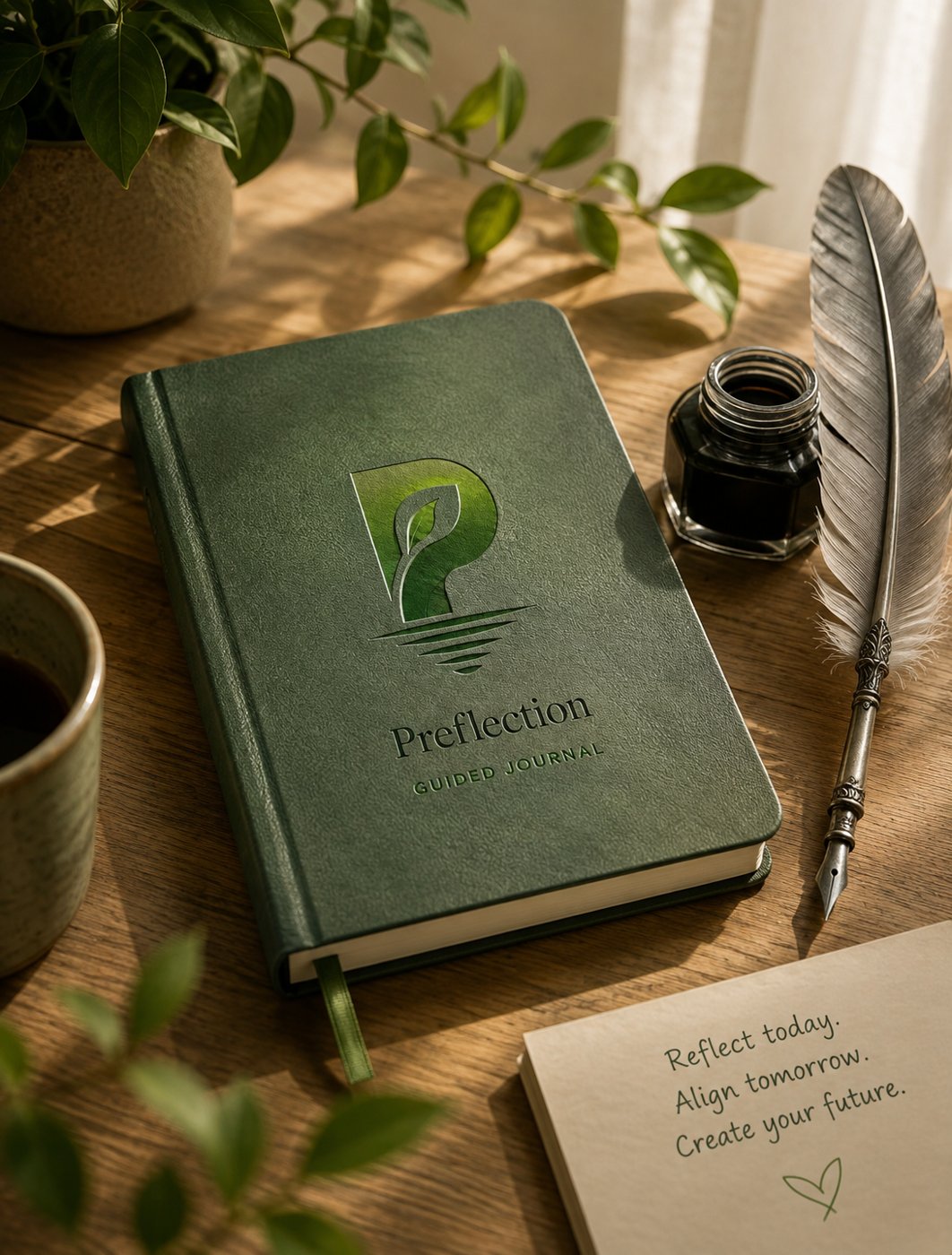
A gentler way to practise
Preflection is a free reflection app built around three simple practices: today, tomorrow, and your North Star values. If you'd like a quiet question to sit with each day — without the blank-page pressure — you're welcome to try it.
What is a guided journal?
A guided journal is a journal that uses questions, prompts or structured exercises to guide your reflection.
A traditional journal gives you complete freedom. You can write about whatever you want, whenever you want.
A guided journal gives you a starting point.
That might be:
- What mattered most to you today?
- What emotion did you notice most strongly?
- What did you learn about yourself?
- What are you grateful for?
- What would you like to approach differently tomorrow?
- What value did you live by today?
- What have you been avoiding?
- What is something you want to remember about this moment?
There is no single right way to do it. Guided journalling can be used for gratitude, emotional awareness, personal growth, mindfulness, goal setting, relationships, values, creativity, or simply making sense of an ordinary day.
The structure is there to help you look inward. It is not there to tell you what you are supposed to find.
There is evidence that journalling can support emotional processing, self-awareness and wellbeing, although the benefits vary from person to person. It is a useful wellbeing practice, but it is not a replacement for professional support when that is needed.
Why use a guided journal instead of a blank notebook?
A blank journal gives you freedom.
That is its greatest strength, but it can also be its biggest weakness.
When you already know what you want to explore, that freedom is wonderful. You can follow a thought wherever it takes you.
But if you are tired, overwhelmed, or simply new to journalling, complete freedom can become another form of friction.
A guided journal removes one simple question:
What should I write about?
You can just begin.
This can be particularly useful if you want to develop a reflection practice but keep finding yourself starting and stopping. A little structure can make it easier to return to the practice without having to reinvent it every time.
And something else happens when someone asks you a good question.
You sometimes discover that your first answer wasn't really the answer at all.
You might be asked:
What was the best part of your day?
And as you think about it, you realise that the moment you remember most clearly wasn't the obvious highlight.
Maybe it was a five-minute conversation.
A song.
The feeling of sunlight through a window.
Someone holding a door open for you.
A moment when you laughed unexpectedly.
The guided journal didn't create those moments.
It helped you notice them.
A guided journal is not a test
This is probably one of the most important things to understand about guided journalling.
There is no correct answer.
If a prompt asks, "What are you grateful for today?" and you genuinely aren't feeling particularly grateful, you don't need to manufacture an answer because you think you should.
You can write:
I'm struggling to think of anything.
That is an honest answer.
And honesty is usually more useful than positivity for its own sake.
Reflection can become unhelpful when we turn it into another performance. We start trying to become the person we think we are supposed to be instead of paying attention to the person we actually are.
A good guided journal should make it easier to be curious about yourself without immediately judging what you find.
Sometimes the most valuable thing you can write is the thing you didn't think you were supposed to say.
Guided journal vs gratitude journal
Gratitude journalling is probably the best-known form of guided journalling.
There is good reason for its popularity. Deliberately noticing positive experiences can help us pay attention to aspects of life that might otherwise disappear into the background.
But gratitude isn't always the best place to begin.
I discovered this myself.
For a long time, I wrote gratitude lists because I had been told that gratitude was good for me.
Health.
Family.
A roof over my head.
Food on the table.
All true.
All worth appreciating.
And yet I often found myself writing the same things without genuinely feeling them.
It felt like I was saying the right words rather than actually paying attention to my life.
Eventually I realised something important.
I didn't need to manufacture gratitude. I needed to notice more.
The meaningful moments were already there.
Reflection helped me find them.
And sometimes gratitude followed naturally.
That idea became one of the foundations of Preflection.
Guided journalling can help you reflect without overthinking
There is an important distinction between reflection and rumination.
Reflection asks:
What happened?
What did I feel?
What can I learn from this?
What matters here?
Rumination tends to keep asking the same questions without getting anywhere.
Why did this happen?
Why am I like this?
What if I had done something differently?
Why can't I stop thinking about this?
Reflection creates perspective.
Rumination can create a loop.
That doesn't mean difficult thoughts should be avoided. Quite the opposite. Sometimes the things we most need to understand are uncomfortable.
But reflection works best when there is some movement.
You look backward, understand something, and then carry that understanding forward.
That is one reason I think a guided journal should eventually take you somewhere.
Not necessarily towards a goal or a solution. Sometimes simply towards a little more understanding.
The best guided journal questions are open
A useful prompt should create space rather than close it.
Compare:
Did you have a good day today?
with:
What stands out to you about today?
The first question asks you to classify the day.
Good or bad.
Positive or negative.
The second asks you to pay attention.
That difference is small, but important.
Our lives are rarely as simple as good days and bad days.
You can have a terrible day and still laugh at something.
You can have an excellent day and still feel anxious.
You can be proud of yourself and disappointed in yourself at the same time.
You can be exhausted and grateful.
You can be afraid and courageous.
Human beings are complicated.
Our journals should have room for that complexity.
10 guided journal prompts for self-reflection
If you're new to journalling, you don't need an elaborate system.
Try one of these questions and write whatever comes to mind.
- 01What stands out about today?
Don't try to summarise everything. Just notice what your mind keeps returning to. - 02What moment would I like to remember?
It doesn't need to be significant. Sometimes the smallest moments are the ones we wish we had remembered. - 03What emotion did I notice most strongly today?
Rather than judging it, get curious about it. - 04What did today teach me about myself?
Perhaps you discovered something about what you need, value or enjoy. - 05What mattered to me today?
Your answer might tell you something about your values. - 06What am I carrying that I don't need to carry into tomorrow?
Sometimes reflection is about noticing what you can put down. - 07Where did I act in a way that felt aligned with the person I want to be?
Look for evidence, however small. - 08What did I almost miss?
This is one of my favourite questions because it encourages you to look beyond the obvious. - 09What would I like to approach differently tomorrow?
Not a list of goals. Just one intention. - 10If today were a chapter in my story, what would I call it?
Sometimes a little distance changes the way we understand an experience.
How often should you use a guided journal?
There is no magic number.
Some people love journalling every morning. Others prefer evenings. Some write several times a week. Others pick up a journal only when there is something they need to work through.
I don't think journalling should become another obligation.
You don't need a 30-day streak.
You don't need to write 1,000 words.
You don't need to feel inspired.
Five thoughtful minutes can be enough to create a little space for yourself.
And if you miss a day?
Nothing has gone wrong.
You simply continue when you're ready.
The point isn't to become someone who journals perfectly.
It is to become someone who pays a little more attention.
What makes a guided journal effective?
I think there are a few things worth looking for.
It should be specific enough to help
"Write about your life" isn't particularly useful when you're staring at a blank page.
A good prompt gives your attention somewhere to go.
It should be open enough to let you be yourself
The question shouldn't force you towards a predetermined conclusion.
Your answer belongs to you.
It should encourage curiosity rather than judgement
The purpose isn't to prove that you're doing life correctly.
It is to understand yourself a little better.
It should connect reflection with action
Insight is useful.
But insight that never changes anything can eventually become another form of thinking.
Sometimes the most valuable question is simply:
What will I carry forward from this?
Guided journalling and values
There is another reason I think guided journalling can be powerful.
The things we repeatedly notice can tell us something about what matters to us.
Think about the moments that make you feel most alive.
The things that frustrate you disproportionately.
The qualities you admire in other people.
The moments you're proud of.
The things you protect.
The decisions you find difficult.
There are clues everywhere.
Our values are often hiding in plain sight.
They show up in what we care about, what we react to, what we admire and what we are willing to stand up for.
This is one of the ideas behind North Star, the values-discovery experience within Preflection.
Rather than simply asking someone which values they think they have, North Star explores how they naturally respond to different situations and uses those choices to surface the values that appear to matter most.
And that changes the nature of reflection.
Instead of simply asking:
Was today good?
You can begin asking:
Did today look like the person I want to be?
That is a very different question.
From reflection to tomorrow
For me, this is where journalling becomes particularly interesting.
Reflection is naturally backward-looking.
You look at what happened.
But we don't reflect simply to live in the past.
We reflect so that we can understand ourselves a little better when we step back into the present.
And then into the future.
Perhaps you noticed that you became unusually frustrated when someone interrupted you.
Perhaps you realised you felt energised after helping someone.
Perhaps you discovered that you have been saying yes to things you don't actually want to do.
Perhaps you noticed how much a particular friendship means to you.
You don't need to turn every insight into a life-changing decision.
Sometimes you simply carry it with you.
Tomorrow might look slightly different because you noticed something today.
That is enough.
A guided journal should eventually become less necessary
There is a strange paradox here.
The best guided journal isn't necessarily the one that keeps you dependent on prompts forever.
The goal should be to become better at noticing your own life.
At first, you might need someone to ask:
What mattered today?
Eventually, you may find yourself asking the question automatically.
You notice the sunset.
You notice the conversation.
You notice the thought that keeps returning.
You notice the way you react to something.
You notice what gives you energy and what drains it.
You notice what matters.
And once you learn to notice, you don't necessarily need a journal to tell you what to look for.
The journal was never the point.
You were.
Guided journalling with Preflection
This is the philosophy behind Preflection.
Preflection is a free reflection platform designed to help you slow down, notice your life and live more intentionally.
It brings together three connected practices:
Today helps you reflect on what happened.
North Star helps you understand and name the values that matter most to you.
Tomorrow helps you carry something meaningful forward.
The intention isn't to fix you.
You don't need fixing.
The intention is simply to create enough space to notice what is already there.
Because sometimes the things we are looking for aren't missing.
We're just moving too quickly to see them.
A final thought
You don't need to become a different person to benefit from journalling.
You don't need to become more positive.
You don't need to have profound insights every night.
You don't even need to write particularly well.
You just need to become a little more willing to pay attention.
Start with one question.
Write honestly.
Notice what comes up.
Then go live your life.
There will always be another day to reflect on.
Related reading
Estimated reading time: 12 minutes · Prompts to keep for a lifetime.