Resources
Mental Health in the Information Age: Why Our Brains Are Tired
A quiet look at what constant stimulation is doing to our minds — and how to find space again.
The best email signature I've ever seen went:
I'm so sorry for not responding to your message right away, I'm trying to process a constant onslaught of information with a brain designed to eat berries in a cave.
I laughed when I read that. Not just because it's amusing, but because of the truth within it.
Our brains really weren't built for this.
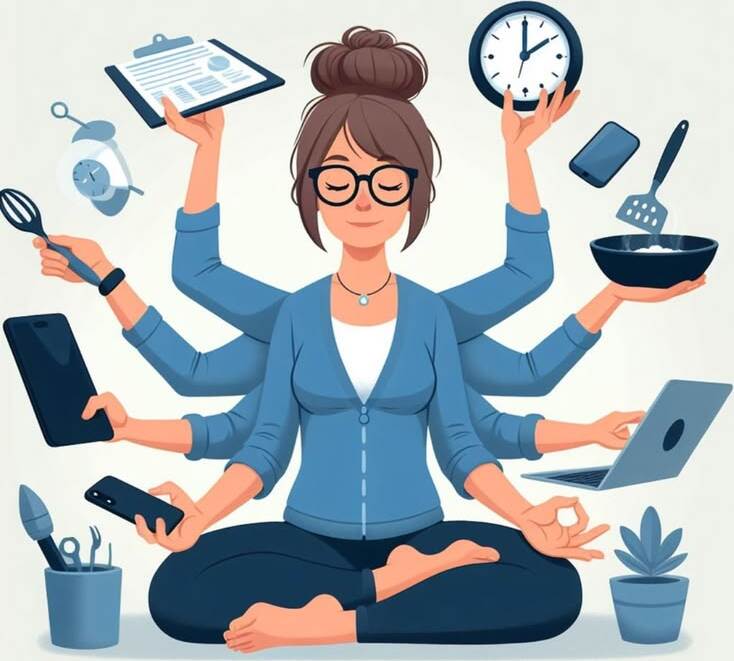
They weren't built for a hundred notifications a day, endless news cycles, group chats, breaking headlines, twenty open browser tabs, and a tiny device in our pockets capable of delivering more information in an hour than our ancestors may have encountered in a lifetime.
And yet here we are.
Trying our best.
No wonder we're tired.
A gentler way to practise
Preflection is a free daily reflection app built around three simple perspectives: your day, this moment, and tomorrow. If you'd like a quiet nudge to sit with a question each evening — without the blank-page pressure — you're welcome to try it.
Living in a Constant State of Stimulation
There was a time when boredom was normal.
You'd wait in a queue and simply... wait.
You'd sit on a bus and stare out of the window.
You'd finish dinner and perhaps read a book, take a walk, or sit with your thoughts.
Today, almost every quiet moment has been filled.
A few seconds of silence at a traffic light? Check your phone.
A commercial break? Scroll social media.
Waiting for the kettle to boil? Open an app.
We've become so uncomfortable with stillness that we reach for stimulation almost automatically.
Not because we're weak.
Because we've been trained to.
The Endless Dopamine Loop
Every notification, every like, every new message and breaking headline offers a tiny hit of novelty.
Our brains love novelty.
It feels rewarding.
The problem is that the reward never lasts.
So we check again.
And again.
And again.
One more email.
One more video.
One more scroll.
One more refresh.
This constant search for stimulation can leave us feeling strangely empty. We consume more information than ever before, yet many of us feel less focused, less present, and less satisfied.
It's a little like eating junk food all day.
You never quite feel full.
Information Overload and Mental Health
Our nervous systems are carrying a lot.
We know about wars happening on the other side of the world.
We know what our old school friends had for breakfast.
We know what celebrities are arguing about.
We know every economic crisis, every disaster, every new trend, every opinion, every hot take.
Human beings were never meant to hold this much information all at once.
The result?
Anxiety.
Mental fatigue.
Difficulty concentrating.
Decision paralysis.
A strange sense that we're always behind.
And perhaps worst of all: the feeling that we should be doing something else.
Something more.
Something better.
Even Rest Doesn't Feel Like Rest
After a long day of work, many of us collapse onto the couch and immediately reach for our phones.
Not because we need to.
Because we don't know how not to.
We call it relaxing, but often we're simply switching from one form of stimulation to another.
Our bodies are sitting still.
Our minds are still running.
Our attention is still being pulled in ten different directions.
The stimulation never ends.
The Fear of Missing Out
And if we're brave enough to put our devices down?
Something else often appears.
Fear.
What if I miss an important message?
What if something happened?
What if everyone else is doing something exciting?
What if I'm falling behind?
This is one of the great ironies of modern life.
We're constantly connected, yet many of us feel more disconnected than ever.
We're consuming more information than any generation before us, yet we often feel less certain, less grounded, and less at peace.
So What Do We Do?
I don't think the answer is to throw our phones into the ocean.
Technology isn't the enemy.
You're reading this on a screen, after all.
The answer is intention.
Creating small spaces where our minds can breathe again.
Moments where we stop consuming and start paying attention.
Moments where we ask:
How am I, really?
What mattered today?
What am I carrying with me?
What do I want tomorrow to look like?
Questions like these sound simple.
But they're surprisingly powerful.
Because the moment you write something down, you've done something important.
You've slowed down.
You've noticed.
You've turned a vague feeling into something you can understand.
You've made a little more room inside your head.
Why Preflection Exists
Preflection was built because I think we're all carrying too much.
Too much information.
Too much noise.
Too much pressure to optimise every aspect of our lives.
There are already enough apps trying to keep your attention.
Preflection doesn't want more of your time.
It wants ten minutes.
No dopamine hits.
No endless scrolling.
No pressure.
No quick fixes.
Just a gentle space to reflect on your day and think about the one ahead.
Some days you'll write a lot.
Some days you'll only answer one question.
Some days you may simply read the questions and sit with them for a few moments.
That's okay too.
There is no wrong way to reflect.
Because Life Happens Off the Screen
I genuinely believe this:
Nothing you read on a screen will change your life.
Your life doesn't need fixing.
It doesn't need optimising.
It doesn't need another productivity system.
It needs attention.
It needs care.
And most of all, it needs living.
The magic isn't in the app.
It's in your ordinary moments.
The conversation with a friend.
The morning sunlight.
The difficult day you survived.
The thing that made you laugh.
The quiet realisation that you're doing better than you thought.
Our brains may have been designed to eat berries in a cave.
But they were also designed to notice beauty, connect with others, and make meaning from our experiences.
Sometimes all we need is a few quiet minutes to remember that.
Related reading
Estimated reading time: 5 minutes