
Resources
We Were Born to Create: Why Making Something Is Essential to Being Human
Somewhere along the way, we became consumers of the world instead of creators within it. Perhaps it's time we remembered what we were made to do.
There is something extraordinary about the human ability to create.
Not just to build a shelter, fashion a tool or put food on the table. I mean the ability to take something that exists only in our minds and bring it into the world. To imagine something that has never been seen, tell a story about something that never happened, paint a landscape that exists nowhere on Earth, or write words that give shape to a feeling we couldn't otherwise explain.
At some point in our evolutionary history, our ancestors developed an extraordinary capacity for symbolic thought, imagination and communication. The archaeological record tells us that early humans, including Neanderthals, were capable of far more than simple survival. They made art, used symbols and left evidence of complex lives.
We began to do something remarkable. We could share not only what we had seen, but what we imagined. We could give form to the invisible. We could tell stories about the past, speculate about the future and invent worlds that existed only in our collective imagination.
And so we told stories. We created myths. We developed religions, philosophies and explanations for the world around us. We looked at the stars, wondered where everything came from, and imagined the forces responsible for bringing it all into existence.
In many traditions, that ultimate source of creation became a creator. And in the Abrahamic tradition, there is a particularly beautiful idea: that humanity was created in the image of God.
There are many ways to interpret that idea. But one interpretation has always resonated with me. If we are made in the image of a creator, perhaps our own instinct to create is not incidental. Perhaps it is fundamental to who we are.
Perhaps we were born to create.
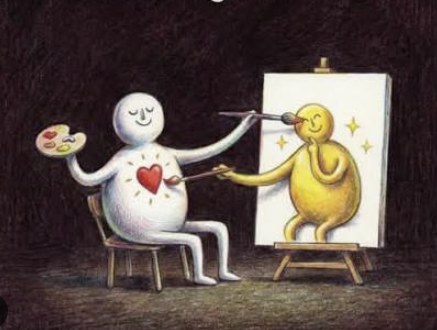
I made it. I'm still here.
Why do birds sing in the morning?
Their songs serve many purposes, from attracting mates to defending territory and communicating with other birds. But I sometimes wonder whether there is something poetic in the timing of it all.
A new day has arrived. The darkness has passed. There is a voice in the trees announcing its presence to the world.
I'm here.
I made it through the night.
Perhaps that's one of the reasons we sing, too. Perhaps it's why we write, paint, build, dance, garden, collect, compose and make things with our hands. Not necessarily to impress anyone or achieve something extraordinary, but simply to express our existence.
To leave something of ourselves in the world.
To say, in whatever language we know how: I made it. I'm still here.
I think there is something deeply human in that impulse. And I think we underestimate how much we need it.
You don't have to be an artist to create art
When we hear the word artist, we tend to imagine a painter in a studio, a musician on a stage or a novelist signing copies of a book.
We've made creativity feel like a profession. Something reserved for the talented, the gifted, the people who have somehow earned the right to call themselves creative.
But what if we've got it backwards?
An artist is simply someone who creates.
A person who tends to a garden, carefully shaping a little patch of the world. Someone who writes in a notebook, even if nobody will ever read it. Someone who collects stamps, restores old furniture, builds model aeroplanes, cooks a meal from scratch or spends an afternoon making something with their hands.
These are all expressions of creativity.
They are ways of taking something that wasn't there before and bringing it into existence. They give form to an idea, an interest, a feeling or an impulse. They create something outside of ourselves, something that might last long after the moment in which it was made.
And it doesn't have to be particularly good.
It doesn't need an audience. It doesn't need to be monetised, published, exhibited or applauded. It doesn't even need to be finished.
The value is often found in the doing.
The things we do, do things to us
Years ago, I found myself in a very dark place.
As a child, I loved writing. I wanted to be an author when I grew up. It was one of those dreams that felt so natural at the time that I never questioned it.
Then I left school, entered adulthood and, somewhere along the way, put that dream aside. For the better part of a decade and beyond, I barely wrote at all.
And then, during one of the darkest periods of my life, I picked up a pen again.
I don't know exactly where the impulse came from. I wasn't trying to become an author. I wasn't trying to build a career or create something that would eventually be read by thousands of people. I simply started writing.
At first, I wrote to understand myself. To make sense of what I was feeling. To put some distance between myself and the thoughts that seemed to consume me.
But something else happened.
I began creating something outside of myself. I took experiences that had been painful, confusing and difficult to carry, and gave them shape. I turned feelings into words, thoughts into stories and fragments of my life into something I could hold in my hands.
It was a kind of alchemy. Turning pain into meaning. Misery into substance. Taking something that felt as though it was consuming me and transforming it into something I had created.
And perhaps, more than anything, I was telling the world something.
I made it.
I'm still here.
The stories I wrote might not have been particularly good. I didn't win awards. I didn't become famous. Nobody was waiting for the next great literary masterpiece.
And that was entirely beside the point.
The joy was in the process. In the hours spent writing, the discovery of a sentence that expressed something I hadn't quite understood before, the quiet satisfaction of bringing an idea to life.
I had rediscovered something I had abandoned for years. And in doing so, I had rediscovered a part of myself.
The finished product was never the point.
It rarely is.
The things we do, do things to us. They change how we see ourselves. They give our time meaning. They create space for feelings that might otherwise remain trapped inside us. They remind us that we are capable of more than simply getting through the day.
I don't think writing saved me because I produced great literature. I think it helped save me because I started creating again.
And I suspect many people are waiting to rediscover that feeling.
The world has made us consumers
We live in an age of extraordinary convenience.
We can summon almost any song, film, book, image or piece of information in seconds. We have access to more entertainment than any generation before us. We can spend an entire evening consuming content without ever having to get up from the sofa.
And now, with artificial intelligence, we have machines capable of writing stories, composing music, generating images, designing buildings and producing things that once required hours of human effort.
There is no denying the possibilities. These tools can be remarkable. They can help us learn, explore ideas, overcome creative barriers and do things that were previously out of reach.
But I do worry about something.
One of the great ironies of the AI revolution is that we are increasingly using machines to do the very thing that makes us human: create.
While machines produce, we consume.
We scroll through an endless stream of images, videos, opinions and entertainment. Much of it is designed not to enrich us, but simply to hold our attention for a few seconds longer. One video becomes another. One feed becomes another. Eventually, we put the phone down, switch off the lights and go to bed.
And sometimes, despite having spent hours being entertained, we feel strangely empty.
Perhaps it's because consuming and creating are not interchangeable.
There is a difference between listening to music and making music. Between reading a story and writing one. Between looking at a beautiful garden and getting your hands into the soil.
Consumption gives us an experience. Creation gives us participation.
It asks something of us. It requires attention, imagination, effort and patience. It brings us into contact with ourselves in a way that passive entertainment rarely does.
And perhaps that is precisely why it can be so rewarding.
I'm not suggesting we throw away our phones, abandon technology or refuse to use AI. That would be neither realistic nor particularly helpful. Technology is here to stay, and there is much to celebrate about what it can make possible.
But we should be careful not to outsource the parts of life that make us feel most alive.
Let the machines help us. Let them handle the tedious, the repetitive and the mundane. But let's not forget to make things ourselves.
Let's not become so accustomed to having everything created for us that we lose the desire, or even the ability, to create.
Create something. Anything.
There is a beautiful idea at the heart of creativity: you don't have to wait until you feel inspired.
You don't need the perfect idea, the right equipment, a spare room or an abundance of natural talent. You don't need to know what you're doing. You don't even need to know what you're trying to achieve.
You simply need to begin.
Write a few sentences. Plant something. Pick up an instrument. Draw badly. Learn to cook something you've never made before. Restore an old chair. Start a collection. Build something. Make something that nobody else will ever see.
Do it because you enjoy it. Do it because you're curious. Do it because there's a part of you that wants to bring something into the world.
And then do it again tomorrow.
You might discover a talent you never knew you had. You might find a new passion. You might make something beautiful. Or you might produce a great deal of work that nobody else considers particularly remarkable.
It doesn't matter.
The act of creating is itself an experience worth having.
There is also something to be said for the way we create our own reality. Not in the sense that we can simply wish away hardship or control everything that happens to us. We can't. But the things we choose to pay attention to, the experiences we seek out and the actions we take all influence the lives we end up living.
Creation is part of that process. We are not merely here to observe the world as it unfolds. We can participate in shaping it.
We can bring beauty into it. Meaning. Ideas. Stories. Gardens. Music. Kindness. Things that didn't exist before we decided to make them.
A small act of rebellion
Perhaps creating something is one of the simplest and most meaningful acts of rebellion available to us.
In a world that wants us to consume endlessly, choose to make something.
In a world that measures everything by its usefulness, make something simply because you enjoy it.
In a world that asks for constant performance, create something that nobody needs to see.
In a world that encourages us to spend our lives watching other people live theirs, get out there and make something of your own.
You don't have to call yourself an artist. You don't have to be particularly good at anything. You don't have to turn your creation into a side hustle, a business or a personal brand.
You just have to start.
Because somewhere in the process, you might find more than a hobby. You might find a way to understand yourself, to give shape to your experiences, to make sense of the world and to reconnect with a part of yourself that has been waiting patiently for your attention.
A way of saying that we made it. That we're still here.
So go and create something. Anything.
The finished product isn't the point. It never was.
A gentler way to practise
Preflection is a free daily reflection app built around three simple perspectives: your day, this moment, and tomorrow. If you'd like a quiet nudge to sit with a question each evening — without the blank-page pressure — you're welcome to try it.
Related reading
Estimated reading time: 7 minutes