
Resources
Can AI Actually Support Mental Wellbeing? I Think It Can—If We Stop Expecting It to Be a Therapist
A reflection on where AI belongs in the conversation about mental wellbeing.
Artificial intelligence seems to be everywhere at the moment.
It's writing emails, creating images, helping us learn new skills and, increasingly, finding its way into the mental wellbeing space.
Depending on who you ask, this is either incredibly exciting or deeply concerning.
Personally, I think both reactions are understandable.
I've seen people confidently declare that AI is the future of therapy. I've also seen others insist it has absolutely no place in conversations about mental health.
As is often the case, I think the truth lies somewhere in the middle.
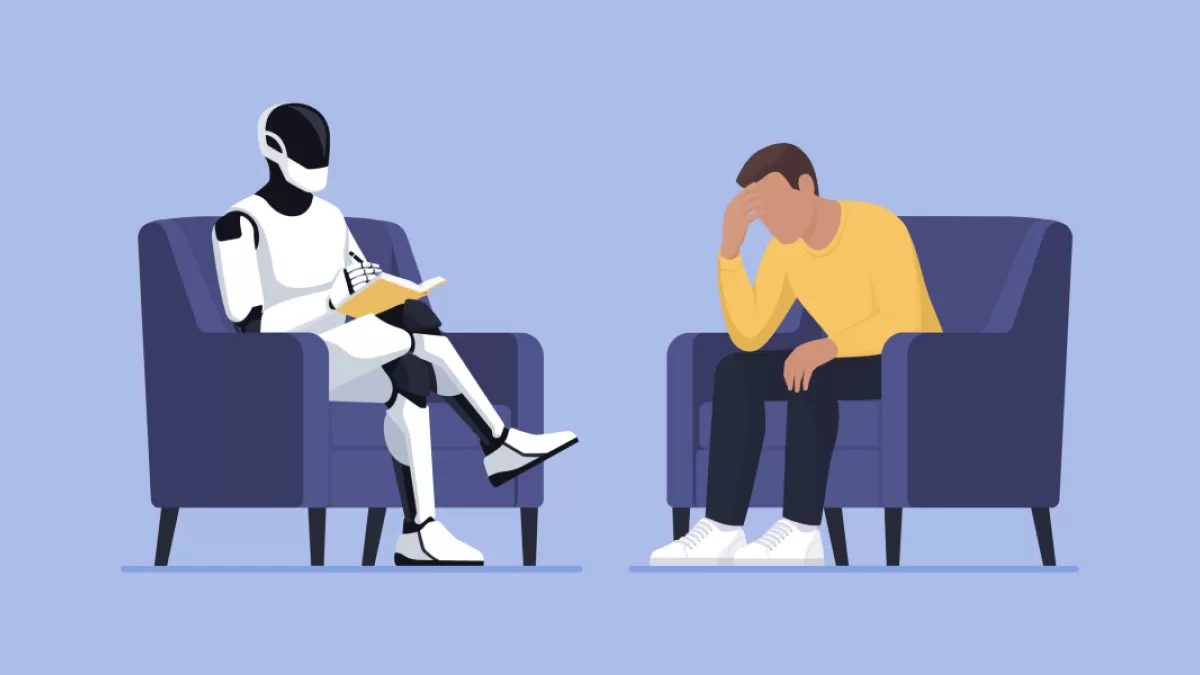
AI is not a therapist
Let's get the important part out of the way first.
Artificial intelligence should never replace qualified mental health professionals.
It cannot diagnose.
It cannot understand the full complexity of being human.
It cannot build genuine human relationships.
And if you're struggling with your mental health, there's no substitute for speaking to someone properly trained to help.
I don't think AI should ever pretend otherwise.
But I also don't think that's where its greatest value lies.
Sometimes we don't need advice
One of the biggest lessons I've learned through years of journaling and reflection is that most of the time, I don't actually need someone to solve my problems.
I already know what I should do.
What I struggle with is slowing down long enough to hear myself think.
That's where I believe technology can quietly help.
Not by telling us what to do.
Not by analysing us.
Not by trying to fix us.
But by helping us pause.
Helping us notice.
Helping us ask better questions.
The most powerful AI doesn't always give answers
One of the most interesting things I've noticed recently is that some independent developers are taking exactly this approach.
A good example is an app called DAWN Vault, created by a fellow independent founder I've had the pleasure of getting to know.
Rather than trying to act like a therapist or life coach, DAWN uses AI in a much gentler way.
After you write a reflection, it mirrors your own thoughts back to you.
Reading your own words through a slightly different lens can be surprisingly powerful. Sometimes it helps you notice patterns you missed. Other times it simply makes you feel heard, even though you know you're reading something generated by software.
What I appreciate most isn't the technology itself.
It's the philosophy behind it.
The AI isn't trying to replace your own thinking.
It's encouraging it.
That's a distinction I think matters enormously.
That's also the philosophy behind Preflection
When I built Preflection, I deliberately avoided positioning it as something that would improve people or optimise their lives.
I don't think most of us need another app telling us how to become better humans.
I think we need more opportunities to become more aware humans.
Reflection helps us understand today.
Preflection helps us prepare for tomorrow.
Neither process works because an app has the answers.
They work because thoughtful questions encourage us to discover our own.
That's why one of my favourite sayings has become:
Your life doesn't need fixing. It simply needs noticing.
The answers have always been there.
Sometimes we just need help finding the questions.
Where I think AI genuinely shines
I don't think AI's greatest strength is giving advice.
I think it's helping us organise our own thoughts.
Helping us slow down.
Helping us recognise patterns.
Helping us prepare intentionally for important moments.
Helping us reflect honestly afterwards.
Used like this, AI becomes something much smaller than a therapist.
But perhaps something equally valuable in everyday life.
A thoughtful companion.
A quiet mirror.
A patient listener that never claims to know us better than we know ourselves.
The future isn't AI versus humans
I don't believe the future of mental wellbeing is choosing between human connection and artificial intelligence.
I think it's understanding where each belongs.
Friends.
Family.
Therapists.
Mentors.
They give us things no machine ever will.
Technology doesn't have to compete with that.
It can simply create a little more space for reflection between those moments.
And if it helps even one person notice something beautiful about an otherwise ordinary day...
I'd say that's technology being used exactly as it should be.
Final thoughts
If you've found a thoughtful app, journal, practice or habit that helps you slow down and reconnect with yourself, hold onto it.
The goal isn't to find the perfect tool.
The goal is simply to notice yourself a little more kindly than you did yesterday.
Because sometimes, that's enough.
A gentler way to practise
Preflection is a free daily reflection app built around three simple perspectives: your day, this moment, and tomorrow. If you'd like a quiet nudge to sit with a question each evening — without the blank-page pressure — you're welcome to try it.
Related reading
Estimated reading time: 6 minutes